The Dark Side of the Sun
In the early 1980s Michael Bird's television career was at its height and his work was in great demand. His friend David Cunliffe, who had directed episodes of The Lotus Eaters, became Head of Drama at Yorkshire Television and wanted Bird to write for him. The BBC was understandably eager for a new series. Not a man to shrink from a challenge, Bird found himself in the Autumn of 1983, at the age of 55, in the unique position of having prime time serials running on both major television channels.
On Tuesday evenings on BBC1, The Dark Side of the Sun introduced us to a darker side of Michael Bird. Set once more in his favourite corner of the Mediterranean, this time on the beautiful island of Rhodes, Bird's newest creation left viewers in no doubt from the outset that evil forces were at work. A tale of supernatural terror, it concerned the discovery of a secret brotherhood of international financiers and politicians meeting clandestinely on Rhodes. The head of the brotherhood, Raoul Lavalliere, had his own secret concerning his ancestor Tibald de Montrefort, a particularly unpleasant individual from the middle ages when the Knights Templar settled on Rhodes.September 2008 marked the 25th Anniversary of
The Dark Side of the Sun.
As a bit of fun Dr Marianne Gilchrist (see below) decided to celebrate the 'silver jubilee' by drawing up a chronology to see how the series' back-story dovetailed with real world events.
It works rather well ...
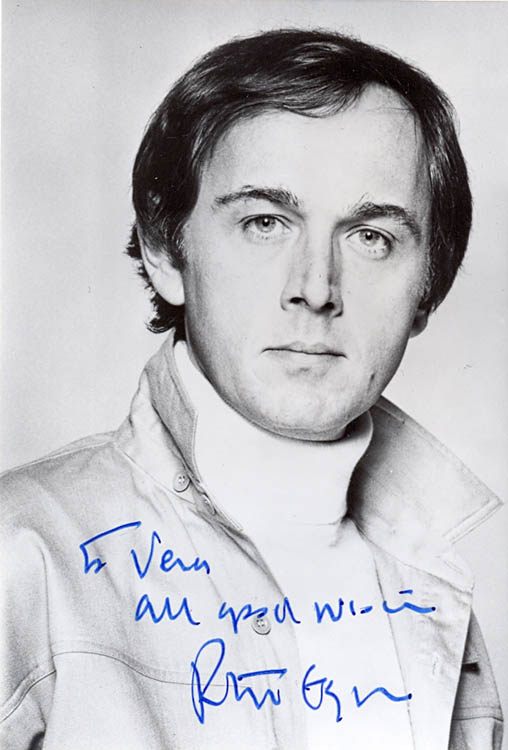
CHRONOLOGYBird gave Lavalliere the ability to cloud minds and to take on the form of another person - specifically that of photographer Don Tierney, played by Patrick Mower. It was a handy talent and one that enabled Mower to appear throughout the series even though his character was killed in the first episode. Lavalliere used his power to bed Tierney's widow leaving her believing her husband had returned. If it sounds vaguely sordid, it was, and Peter Egan's flawless portrayal of pure selfish evil was one of the highlights of the series and Lavalliere a truly memorable screen villain.
Peter Egan recalls that filming on Rhodes took place during a very cold February and March 1983. Emily Richard also recalls the cold. Radio Times reported the production was fraught with difficulties. "The weather was unseasonably bad and there were illnesses and rows and that sort of thing." Emily Richard says there was a taxi strike while they were there and the walk into the centre of Rhodes took one hour. Radio Times stated that a friend had warned Bird not to write about the Knights Templar, saying that bad things would happen.
Although disliked by some critics (one even complained that Patrick Mower's trousers were too tight) The Dark Side of the Sun was immensely popular with viewers. Bird had deliberately left the ending ambiguous. Since his character is seen purchasing a Scottish castle in the closing minutes, and the series was produced by BBC Scotland, Peter Egan confidently expected a sequel - a sort of demonic Monarch of the Glen. In his autobiography "Yes, Mr Bronson", Michael Sheard expressed his surprise that the BBC never repeated the series or commissioned the expected sequel. It remains a mystery. Fortunately this excellent drama did eventually make its way on to DVD.
Dr Marianne Gilchrist, a fan of the series and author of the above chronology, says she was at St Andrews studying mediaeval history when she first saw it. "The series became something of a cult. A mock-baronial wing of our hall somewhat resembled the Scottish castle in the last episode; also some of my friends in another hall spotted the fact that the owners of an adjacent house had a light coloured Mercedes ..."
Dr Gilchrist says: "It crosses my mind that the historical back-story owes something to the dubious end of Foulques de Villaret's career as Master of the Hospitallers on Rhodes. He had conquered the island for his order. However he seems to have gone off the rails in his behaviour, and was forced to abdicate after his order rebelled against him in 1317 (they apparently tried to murder him!). He holed himself up in the castle at Lindos for a time, and was besieged. He eventually retired quietly to France, after the Pope authorised his demotion.
I find the series interesting as another example of the negative 'Templar Myth'. They have never really recovered from their framing by Clement V and Philippe IV, being posthumously co-opted by the Masonic movement in the 18th century, and used as all-purpose villains by Walter Scott. The Cyprus trial material is interesting, as torture was not used (unlike in France), and their innocence was well attested by a range of people. In fact, the Templars had a rather better moral reputation than the Hospitallers (who profited greatly from their suppression).
In terms of the fictional narrative of the serial, Foulques de Villaret is probably the Hospitaller Grand Master who orders the murder of the fugitive Templars and the villagers. Brother Philibert's not-so-very-hidden narrative in the margins of the account book would make sense as a message to his other brethren in engineering de Villaret's overthrow. (Something to pass around at the chapter meeting that ousted the old rascal, perhaps?)
The 'Dracula' overtones are quite strong. The 1973 Jack Palance 'Dracula' was the first to use the idea of Mina as the Count's lost love reincarnated (something the Coppola version also used), and I wonder if this influenced the Anne/Agnès plot-line?
I'm very fond of the series although I think more could have been made of some of its elements. The back-story was potentially very powerful. Had the 14th century Templars been depicted as innocent as they were, Thibaut/Raoul going off the rails would have actually had more force - someone who has lost his moral compass after experiencing a horrific injustice."
Check out Dr Gilchrist's own webpage, TEMPLARIANA, devoted to the treatment of the Templars in fiction. There is a whole section on The Dark Side of the Sun. Marianne has even penned a sequel to Bird's story. So far as I am aware it is the first time anyone has attempted that. You can read more about it on the 'Novelisation' page.